
News
Final Exam SeatingWritten on 08.10.26 by Gregory Stock Liebe Studierende, If you are admitted to and registered for the final exam tomorrow, your personal status page now also shows your assigned seat. If you have not been assigned a seat and believe this is a mistake, please let us know as soon as possible. Please arrive at the lecture hall by… Read more Liebe Studierende, If you are admitted to and registered for the final exam tomorrow, your personal status page now also shows your assigned seat. If you have not been assigned a seat and believe this is a mistake, please let us know as soon as possible. Please arrive at the lecture hall by 09:52 at the latest so that you have enough time to find your seat. Please also make sure you have read the previous news item. Viele Grüße |
Project 3 Grading, Cheat Sheet, and Final ExamWritten on 06.10.26 by Gregory Stock Liebe Studierende, We have now evaluated all submissions for the third project, though so far only the mandatory tasks have been graded. You can see whether you passed on your personal status page. For those who passed all three projects, the final exam takes place on Friday, 9 October, starting… Read more Liebe Studierende, We have now evaluated all submissions for the third project, though so far only the mandatory tasks have been graded. You can see whether you passed on your personal status page. For those who passed all three projects, the final exam takes place on Friday, 9 October, starting at 10:00. The exam will last about 90 minutes. You will need your national ID card or passport and your student ID card, as well as writing utensils (indelible pen, neither red nor green ink). You can bring a single handwritten (not printed), double-sided A4 cheat sheet to the exam. You will not need your own paper, and you will not be allowed to use a calculator. Viele Grüße |
Final Exam RegistrationWritten on 25.09.26 by Gregory Stock Liebe Studierende, In two weeks, on Friday, 9 October, we’ll write the final exam. You must register for the exam if you wish to take part. The registration closes one week before the exam. If you miss this deadline, you will be unable to participate in the exam. The registration modalities… Read more Liebe Studierende, In two weeks, on Friday, 9 October, we’ll write the final exam. You must register for the exam if you wish to take part. The registration closes one week before the exam. If you miss this deadline, you will be unable to participate in the exam. The registration modalities differ across study programmes:
If you have any questions about or issues with the exam registration, please contact us and your study coordination/examination office before the registration deadline. Viele Grüße |
Guest Lecture by Pedro R. D’Argenio (FAMAF, UNC) on Routing in DTNsWritten on 23.09.26 by Santiago Henn Liebe Studierende, Tomorrow (24 September) at 09:30 we are going to jointly enjoy a guest lecture by Prof. Pedro R. D’Argenio (FAMAF, Universidad Nacional de Cordoba, Argentina) officially entitled “Optimal Routing in Uncertain DTN using Markov Decision Processes”. The presentation will… Read more Liebe Studierende, Tomorrow (24 September) at 09:30 we are going to jointly enjoy a guest lecture by Prof. Pedro R. D’Argenio (FAMAF, Universidad Nacional de Cordoba, Argentina) officially entitled “Optimal Routing in Uncertain DTN using Markov Decision Processes”. The presentation will take place in our usual lecture hall 0.01 in E1 3. The lecture is open to everyone, so do feel free to spread this information to your peers. Please note that this guest lecture will not be recorded. The content of the lecture is part of the course and may be relevant for the exam, just like the content of our other lectures. See you there! |
Shared Lectures with Sustainable Computing SystemsWritten on 22.09.26 by Santiago Henn Liebe Studierende, Please note that the two lectures scheduled for tomorrow (23 September) will be held jointly with the Sustainable Computing Systems course. The lectures will take place in the usual room (lecture hall 0.01 in E1 3), but the schedule differs from the regular… Read more Liebe Studierende, Please note that the two lectures scheduled for tomorrow (23 September) will be held jointly with the Sustainable Computing Systems course. The lectures will take place in the usual room (lecture hall 0.01 in E1 3), but the schedule differs from the regular timetable:
Please note that these shared lectures will not be recorded. The content of the lecture is part of the course and may be relevant for the exam, just like the content of our other lectures. In addition, feel reminded that tomorrow’s Office Hour starts at 14:45 and takes place in Room 528 of building E1 3 (5th floor). Viele Grüße |
Relocation - 22/09 afternoon lecturesWritten on 22.09.26 by Santiago Henn Liebe Studierende, |
Project 3 ReleasedWritten on 22.09.26 by Santiago Henn Liebe Studierende, The third and last project has now been released. You can find the task description on the materials page. The deadline for this project is 4 October at 23:59. Please note that only one team member needs to upload the team submission to their personal status page. The project… Read more Liebe Studierende, The third and last project has now been released. You can find the task description on the materials page. The deadline for this project is 4 October at 23:59. Please note that only one team member needs to upload the team submission to their personal status page. The project includes two optional activities. If you successfully complete all required activities and both optional activities, you will receive an additional 0.3 points toward your final grade. IMPORTANT: If you submit your project by 30 September at 23:59, you will be notified by 2 October at 23:59 whether you have passed the project and are eligible to proceed to the exam. You may continue updating Project 3 until the deadline for the optional activities, even if you have already passed. Any improvements and optional activities submitted by that deadline will still be considered toward improving your final grade. There will be an Office Hour on Wednesday, 23 September, at 14:45 where you can ask questions regarding the project. It will take place in Room 528 of building E1 3 (5th floor). We are currently discussing the possibility of offering additional Office Hours in the next week. As the details have not yet been finalised, we encourage you to regularly check the dCMS calendar for updates. In the meantime, please remember that our forum remains available at all times and should be your primary channel for project-related questions. We wish you success with the final project! Euer Space Team |
Project 2 ReleasedWritten on 11.09.26 (last change on 21.09.26) by Gregory Stock Liebe Studierende, The second project has now been released. You can find the task description on the materials page. The deadline for this project is 20 September at 23:59. Please note that only one team member needs to upload the team submission to their personal status page. Please also… Read more Liebe Studierende, The second project has now been released. You can find the task description on the materials page. The deadline for this project is 20 September at 23:59. Please note that only one team member needs to upload the team submission to their personal status page. Please also remember the deadline for forming teams (15 September at 23:59), as well as the supporting Office Hours (as announced in a previous news). Viele Grüße |
Guest Lecture by Wesley Woo (Virginia Tech) on SpaceX StarlinkWritten on 11.09.26 by Gregory Stock Liebe Studierende, Today (11th September) at 09:30 we are going to jointly enjoy a guest lecture by Wesley Woo (Virginia Tech) It is about the SpaceX Starlink constellation and officially entitled “Towards System-wide Modeling of Coverage and Capacity of LEO Constellations”. The… Read more Liebe Studierende, Today (11th September) at 09:30 we are going to jointly enjoy a guest lecture by Wesley Woo (Virginia Tech) It is about the SpaceX Starlink constellation and officially entitled “Towards System-wide Modeling of Coverage and Capacity of LEO Constellations”. The presentation will take place in our usual lecture hall 0.01 in E1 3. The lecture is open to everyone, so do feel free to spread this information to your peers. We apologize for the delayed announcement and hope that you can still join us on short notice. Please note that this guest lecture will not be recorded. The content of the lecture is part of the course and may be relevant for the exam, just like the content of our other lectures. See you there! |
Project 2: Team CreationWritten on 09.09.26 by Gregory Stock Liebe Studierende, The second project will be released on Friday. As previously announced, this is a team project in which you may work in groups of two students. You are invited to team up on your own via your personal status page under the “Teams” section: One person in each team must Liebe Studierende, The second project will be released on Friday. As previously announced, this is a team project in which you may work in groups of two students. You are invited to team up on your own via your personal status page under the “Teams” section: One person in each team must Please note that we are offering three Office Hours to support you with the project or to discuss any other questions. Check the dCMS calendar for details. Please note, however, that all three Office Hours will take place in Room 528 of building E1 3 (5th floor). Viele Grüße |
Project 1 ReleasedWritten on 04.09.26 by Gregory Stock Liebe Studierende, The first project has been released. You can find the task description on the materials page. Please upload your submission to your personal status page before 23:59 on 13th September. This project requires you to use STK. Visit the Office Hour today (4th September) at 12:30… Read more Liebe Studierende, The first project has been released. You can find the task description on the materials page. Please upload your submission to your personal status page before 23:59 on 13th September. This project requires you to use STK. Visit the Office Hour today (4th September) at 12:30 for support with installation or to ask any other questions. Viele Grüße |
Welcome to Space!Written on 28.08.26 by Gregory Stock Liebe Studierende, Welcome to Space Informatics! Our course will start next week. The first lecture will take place on Monday, August 31, at 09:30 (s.t.) in lecture hall 0.01 of building E1 3. A provisional schedule can be found in the dCMS calendar. Further details will be presented during the… Read more Liebe Studierende, Welcome to Space Informatics! Our course will start next week. The first lecture will take place on Monday, August 31, at 09:30 (s.t.) in lecture hall 0.01 of building E1 3. A provisional schedule can be found in the dCMS calendar. Further details will be presented during the first lecture. Please feel free to contact us if you have any further questions. Viele Grüße |
Space Informatics
A module offered by the Chair of Dependable Systems and Software, planned as a block course in September/October 2026. It is worth 6 ECTS credits.
The course will begin on August 31 with the first lecture happening at 09:30 (s.t.) in lecture hall 0.01 of building E1 3. Check the dCMS calendar for more details. Lectures will be recorded and be made available to our participants, on a best-effort basis.
Context
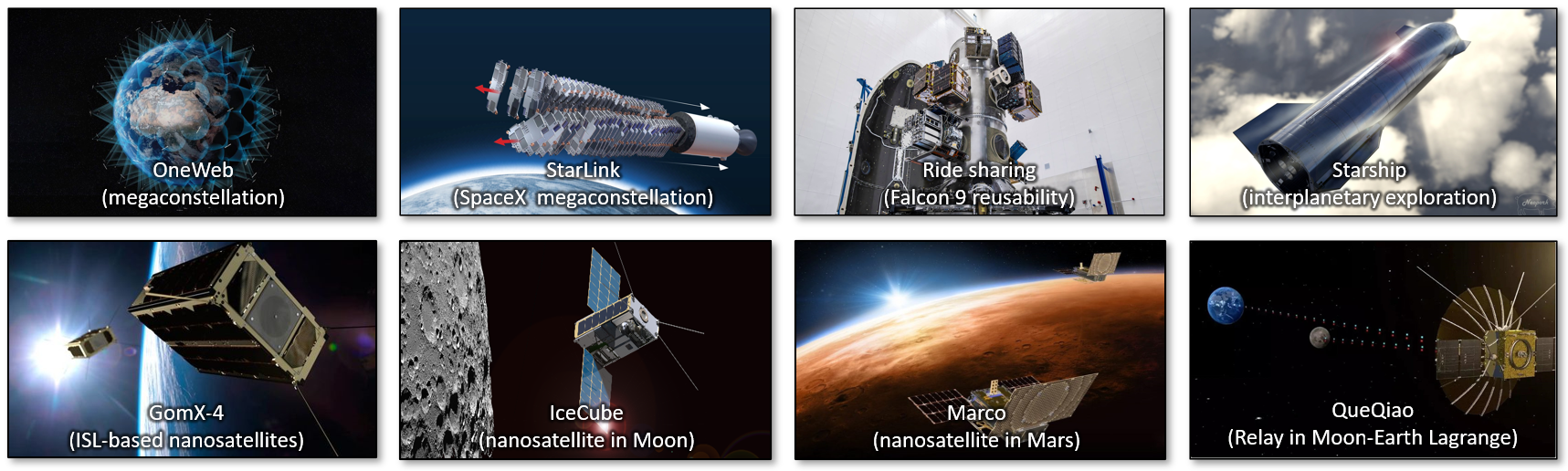
Space technology is experiencing an unprecedented expansion, commonly referred to as the “New Space” paradigm.
Large satellite mega-constellations, comprising thousands of spacecraft, are being deployed primarily in near-Earth orbit to provide global Internet connectivity and near real-time imaging. This is enabled by lower cost and reusable rockets, which are launching more and cheaper spacecraft than ever before. Indeed, nano‑satellite platforms, with volumes of only a few litres, increasingly exploit advances in miniaturised electronics to deliver capabilities that were once exclusive to large spacecraft.
Consequently, space is becoming more democratic, accessible to many academic actors, and open for start-ups to develop innovative commercial opportunities. Moreover, these technological advances are extending to interplanetary robotic exploration missions and, in turn, support the growing prospects for crewed missions to the Moon and Mars in the coming decades.
Motivation
The amount and features of “New Space” orbital assets would simply fail to scale up without the proper support of automated, optimal, efficient, scalable, usable, and robust computer science models and techniques, combining both on-board and on-ground components.
Informatics also plays a decisive role in facilitating a more sustainable space with accurate battery models, delay-tolerant data handling, trajectory optimization, debris collision avoidance, system verification and validation, and online telemetry learning, among many other application opportunities.
Space is within reach, and future space professionals with expertise in space informatic will become a valuable resource in the immediate future of the space industry.
Space Informatics
The Space Informatics course is framed in the New Space context and motivated by the hypothesis that computer science will play a central role in future near-Earth and interplanetary missions. To this end, we present a curriculum layout organized in three thematic dimensions:
- the fundamentals of the space environment, ranging from orbital dynamics to maneuvers and interplanetary trajectory design;
- the specifics of space technology, comprising energy handling, computers, communications, and networking;
- the applications of informatics to 1. and 2., including linear and dynamic programming, model checking, and scheduling techniques.
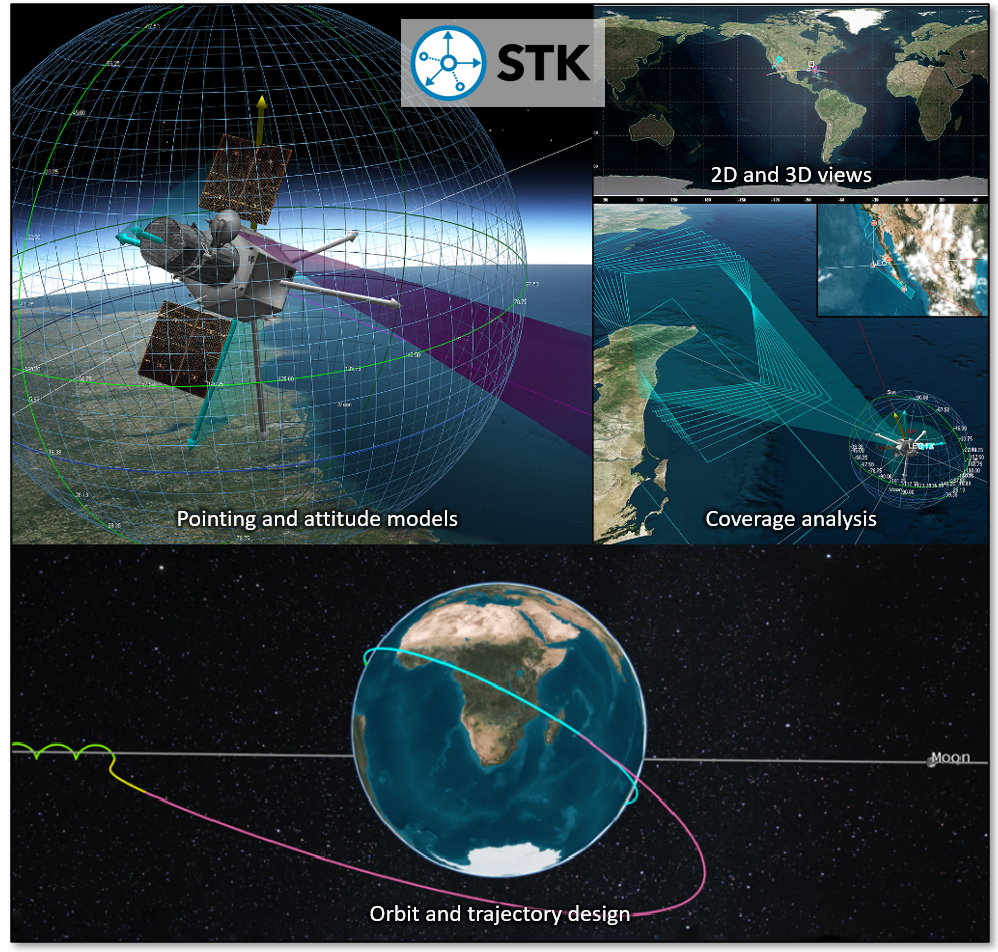
These axes are accompanied by practical exercises and hands-on projects involving state-of-the-art software toolchains such as Systems Toolkit (STK). We will exploit scriptable interfaces (Python) to control STK and evaluate and optimize distributed space missions using informatics modelling tools such as Gurobi and Uppaal.
Contents
- Fundamentals
- Space Applications
- New Space
- Physics and Orbits
- Propagation and Perturbation
- Launch and Maneuvers
- Trajectories Design
- Technology
- Satellite Technologies
- Basic Communications
- Link Budget and Multiplexing
- Space Networks
- Transport Layer
- Simulation and Analysis Tools
- Informatics
- Linear and Dynamic Programming Optimization
- Battery-Aware Scheduling
- Contact Plan Design
- Routing in LEO
- Machine Learning in Space